
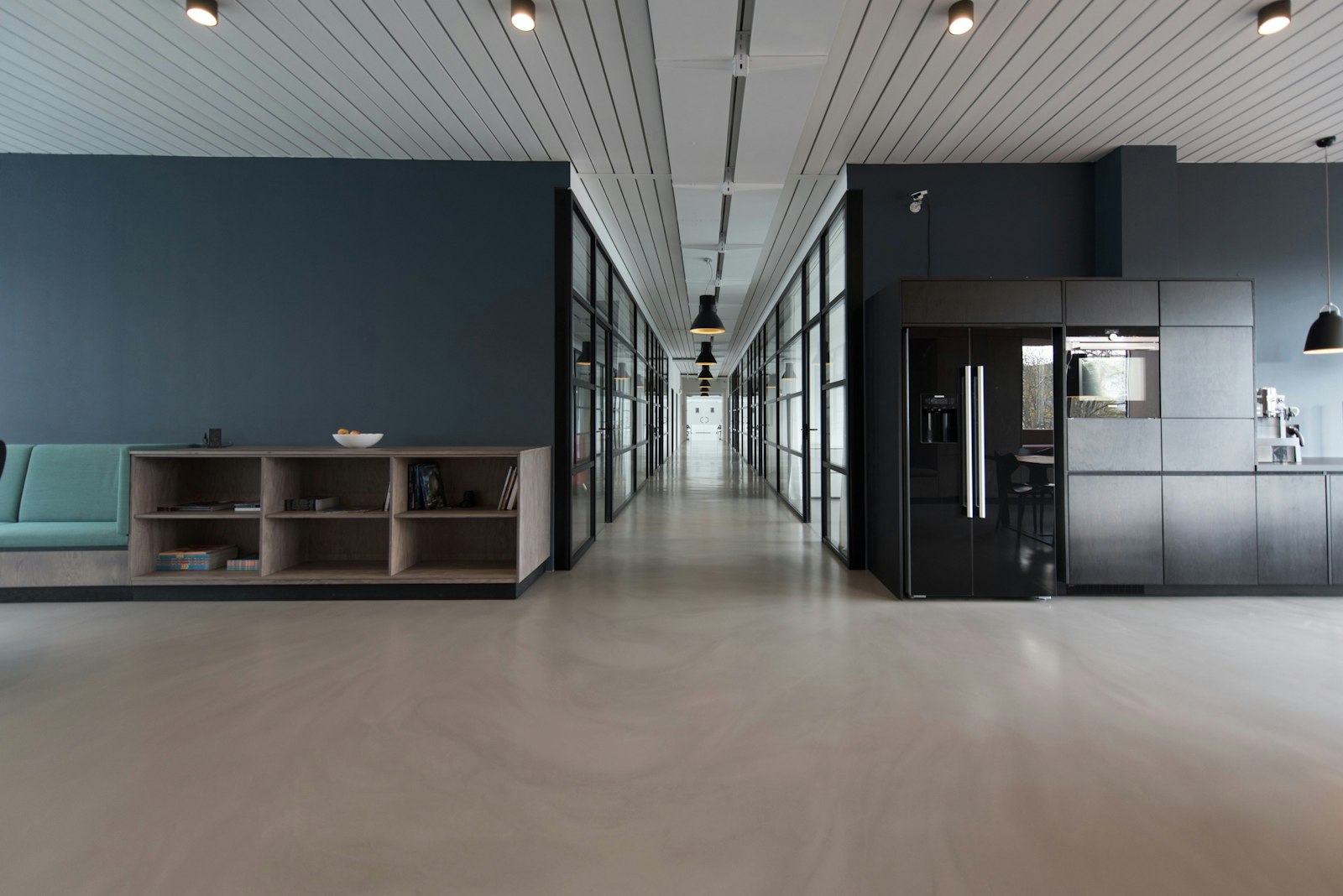
Photo: Nastuh Abootalebi / Unsplash
Renting vs. buying office space in Bucharest: what to choose in 2026
For a team of 10 – 50 people, the choice between renting and buying is not purely financial. We look at flexibility, real cost, ROI and which choice makes sense for each company stage.
One of the most frequent questions I get from entrepreneurs is: "should I rent or buy the office?"
The answer depends less on the spreadsheet and more on the company's stage and its plans for the next 5 – 10 years.
If you treat this purely as a yield calculation, you risk making the wrong choice. Here is what really matters.
Real cost — beyond the headline price
For a rental (example: 950 EUR/month for a 60 sqm module in the Unirii area, VAT and utilities included), the monthly budget is predictable: rent + (possibly) maintenance. Done.
For a purchase, the acquisition price (1,500 – 3,500 EUR/sqm in good Bucharest areas) is just the start:
- Notary and taxes — 1 – 3% of value
- Fit-out — 200 – 500 EUR/sqm for a decent finish
- Furniture and equipment — separate
- Annual maintenance — 1 – 2% of property value
- Building tax — variable, but not negligible for commercial spaces
- Opportunity cost of locked-up capital
For a growing company, the 100,000 – 200,000 EUR invested in an office may be more useful in marketing, hiring or expansion.
Flexibility — the real difference
Companies rarely know where they will be in 5 years. Fast-growing ones outgrow their offices. Restructuring ones pay for empty space.
Renting allows:
- Quickly scaling space up or down
- Changing location — if a new area becomes strategic
- Modular layouts — some buildings (like the one we have at Unirii) offer 60, 120 and 180 sqm modules in the same building, so you can grow without moving
Buying ties you to a location. If you want to move, you go through a sale process that can take 6 – 18 months.
When renting makes sense
I recommend renting in the following cases:
- The company is under 5 years old or in a phase of rapid growth
- Headcount will change (up or down) by more than 30% in the next 2 years
- Location is strategically important (clients, talent, visibility)
- Capital is more valuable invested operationally than locked into real estate
- The activity depends on a specific area that may shift
In practice, for most companies under 50 employees, renting is the right choice. Especially in buildings with utilities included, maintenance covered and modular flexibility (such as those we broker at Unirii or Iancului), the budget remains predictable and capital stays free.
When buying makes sense
Buying makes sense if:
- Your activity is stable and you will not relocate in the next 10+ years
- You have surplus capital after all other operational priorities are covered
- You want to generate passive income — by renting out part of the space or long term
- The company is consistently profitable and needs fixed assets on the balance sheet
- The chosen location has clear potential for appreciation (zones in transformation but already connected to infrastructure)
The most common mistake
A mistake I often see: companies 2 – 3 years old buy a headquarters because "they will grow." They then grow faster than expected, the office becomes too small, but they cannot sell quickly. Result: employees split across two locations, double costs, frustration.
For companies under 5 years old, my rule is: rent a space with expansion options in the same building. Move into a larger module when the time comes, with no real relocation.
Check these details before signing (either option)
Regardless of choice, ask:
- How many kW the electrical connection has — modern offices consume more than people think
- The building structure — fixed modules or reconfigurable walls
- How many parking spots are included and how many can be rented additionally
- What access hours are — buildings with 24/7 security are essential for teams working unconventional hours
- The real monthly cost — rent + maintenance + utilities, calculated correctly
What we can do for you
We help you clarify the brief (surface, area, budget, planned growth window) and then present only the options that make sense — without sending you to 10 useless viewings.
See the full office portfolio or book a call. On the same day you can have a short list of spaces that truly match your requirement.
Looking for an industrial or commercial space?
Browse our portfolio or contact us directly for a personalized analysis.