
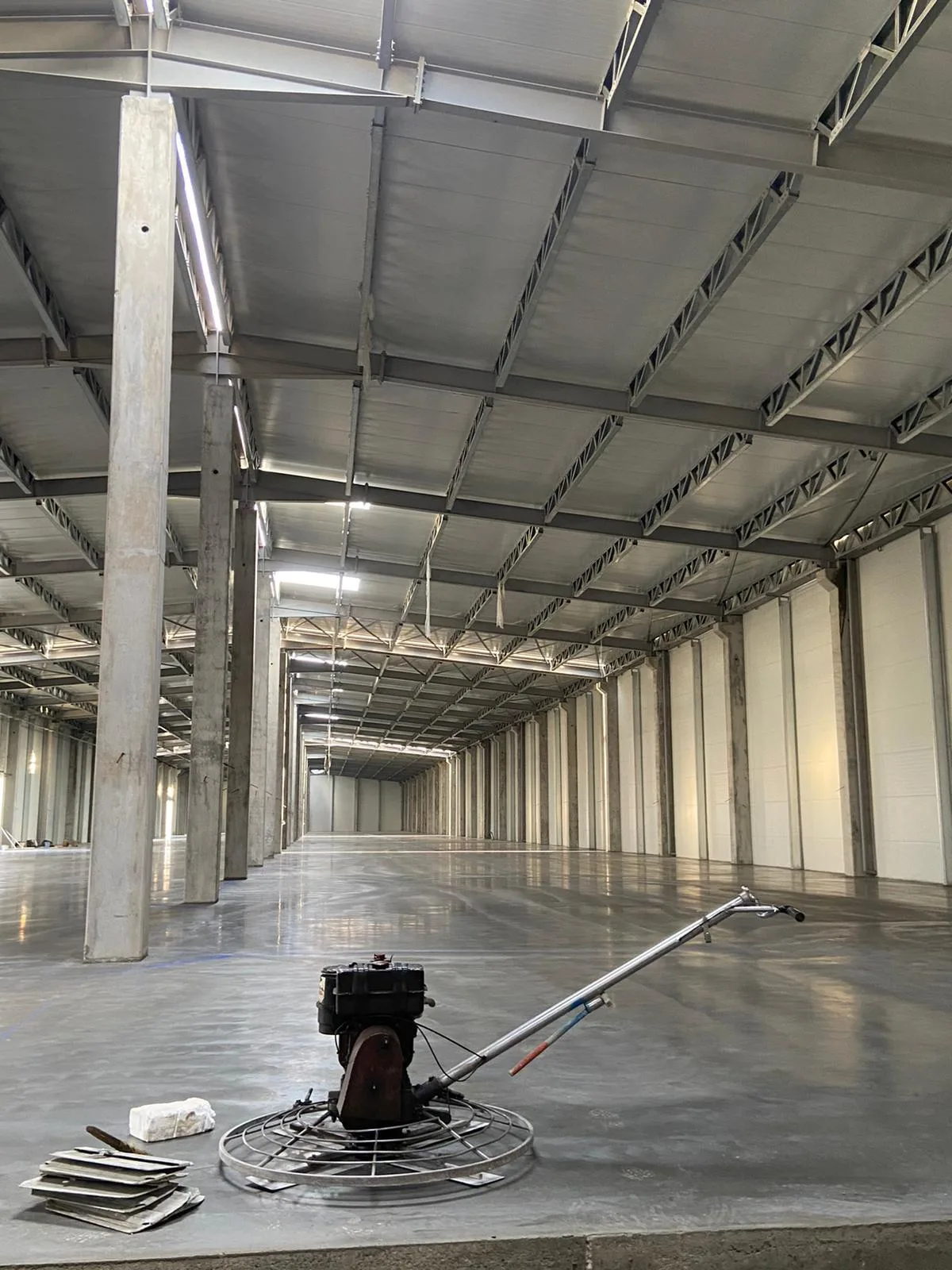
Photo: from the Manager Imobiliar portfolio — new-build unit, Afumați – Șindrilița
Logistics space for e-commerce: the criteria that actually matter
An e-commerce warehouse is not chosen like a conventional one. Picking density, the returns area, courier access and seasonality completely reorder the priority list.
An online retailer renting its first warehouse almost always makes the same mistake: looking for the lowest price per square metre.
That is the right criterion for conventional storage — goods that arrive on a pallet, sit, and leave on a pallet. For e-commerce, where the same building processes hundreds of individual orders a day, each with picking, packing and returns, price per square metre is the fourth or fifth most important criterion.
I have worked with e-commerce companies that moved twice in three years because the first space, cheap as it was, could not carry the volume. Here is what matters, in the order it matters.
1. Picking density, not floor area
In an e-commerce warehouse, order processing time is driven by how far the operator walks, not by how much stock fits.
A long, narrow 1,000 sqm unit can be slower than a compact 700 sqm one. The distance walked for a three-item order can differ by 40% between two buildings of identical size.
What to check: the shape of the space, column positions, and whether you can lay out racking in short aisles with packing in the middle. Ask for the dimensioned floor plan, not just the area.
Height matters, but differently than in conventional logistics. For manual picking, fast-moving stock has to sit between 0.5 and 1.8 m — the rest of the height is only useful for reserve stock. A well-organised 6 m building beats a badly organised 10 m one. The units on Drumul Între Tarlale, 590–1,180 sqm modules at 6 m, are a good example of space suited to medium-volume manual picking.
2. The returns area — the space nobody budgets
In e-commerce, between 5% and 30% of orders come back, depending on category. Fashion sits at the top of that range.
Every return needs physical space for receipt, inspection, refurbishment and restocking. It is a completely separate flow from outbound, and without its own area it blocks packing exactly when you are busiest.
Rule of thumb: allocate 10–15% of usable floor area exclusively to returns. If the space you are viewing cannot accommodate that without choking the main flow, it is too small — whatever the stock calculation says.
3. Courier access
This is where most plans break.
An e-commerce warehouse does not receive trucks daily; it receives 3–8 courier vans, all inside the same two-hour window, in the evening. You need:
- Manoeuvring space and parking for several vans at once
- Ground-level access or an adjustable dock — most courier vans do not match a standard truck dock height
- An access road that does not gridlock at peak hour
Visit the area at the hour your couriers will actually arrive, not at 11am when you tour the building. A location with direct street access, such as the Voluntari units next to METRO, solves this better than a unit inside an industrial park with a single gate and a queue at the barrier.
4. Seasonality and lease flexibility
An online retailer's November–December volume can be three to four times the annual average.
You have two bad options and one good one:
- Rent for the peak — you pay twelve months for space used at 30% the rest of the year.
- Rent for the average — you choke exactly when you are making the money.
- Rent for the average, in a building where you can take extra space temporarily.
The third is the only healthy one, and it is why modular buildings are worth more than their headline rent suggests. The new-build in Afumați – Șindrilița lets in modules from 1,000 up to 6,000 sqm in the same building — you can start at 1,000 sqm and expand seasonally without moving the operation.
Negotiate an expansion clause from the outset, with a pre-agreed rate for adjacent space. It costs nothing at signing and is worth a great deal in year two.
5. Installed electrical capacity
An e-commerce warehouse draws far more power than a conventional one: packing stations, label printers, conveyors, computers, bright lighting across the whole floor, sometimes temperature-controlled zones.
Check the installed capacity, not merely that a connection exists. Upgrading capacity later takes months and costs thousands of euros — and in some areas simply is not possible.
Ask explicitly how many kW are available and ask to see the documentation, not the landlord's verbal assurance.
6. Labour
An e-commerce warehouse running 500 orders a day needs 6–10 operators, and double that at peak. This is hard-to-find staff with high turnover.
A building 30 km out of town with no public transport will cost you either organised shuttles, higher wages, or unfilled positions in November — when it hurts most.
Areas reachable by public transport — Theodor Pallady, Pantelimon, Voluntari — hold a real advantage here that frequently offsets a rent 1–2 EUR/sqm higher. See also the full comparison of industrial areas around Bucharest and Ilfov.
7. Only now: price
Once you have filtered on the criteria above, two or three options usually remain. Only between those do you compare price — and you compare it in total, not per square metre:
- Rent + utilities + service charge
- Transport cost to couriers and customers
- Labour cost in that location
- The estimated cost of relocating in two years, if the space cannot grow
A 4 EUR/sqm building with no room to expand is more expensive over three years than a 6.5 EUR/sqm one with an expansion clause — for any company that is growing.
The short checklist
Before signing, confirm:
- Dimensioned plan with column positions, not just the floor area
- Dedicated returns area (10–15% of usable space)
- Manoeuvring and parking for 3+ vans simultaneously
- Ground-level access or an adjustable dock
- Installed electrical capacity, documented in kW
- Expansion clause at a pre-agreed rate
- Public transport access for operators
- A rent-free period to fit out the packing area
If this is your first move
The most common error is sizing the warehouse against current stock. Size it against the order volume you expect in 18 months, and make sure the lease lets you grow inside the same building.
You can browse the available industrial space or contact me to discuss what fits your flow — I walk the site with clients and check exactly the points above before recommending a space.
Looking for an industrial or commercial space?
Browse our portfolio or contact us directly for a personalized analysis.